Cluster #4 — Bearing Replacement
A focused wheelchair bearing replacement guide covering bearing types, five quantitative wear signs, a replace-vs-continue TCO cost model, step-by-step replacement procedures, and a bulk procurement checklist with cross-brand compatibility reference. Structured bearing replacement reduces push resistance and operational noise incidents by up to 40% across institutional fleets.
wheelchair wheel bearing
wheelchair bearing wear signs
wheelchair bearing supplier
01 The Hidden Operational Cost
Why Worn Wheelchair Bearings Are a Silent Drain on Institutional Budgets
Flat tires stop a wheelchair. Failed brakes endanger a patient. But worn bearings do something more insidious — they quietly inflate operating costs every single day, unnoticed by procurement departments that only track capital expenditures. As outlined in our complete manual wheelchair maintenance guide, bearing degradation is the single largest contributor to “push effort creep” — the gradual increase in force required to move a wheelchair — which directly drives nursing labor fatigue, patient dissatisfaction, and premature component replacement cascades.
Unlike brake failure — which produces an immediate safety event — bearing wear accumulates silently. A caregiver pushing a wheelchair with degraded bearings exerts more energy per trip. Over a 12-hour shift across 20 patient transfers, that incremental effort translates into measurable nursing labor inefficiency. Patients complain about noisy, hard-to-push chairs. Maintenance teams field repetitive work orders. And because procurement tracks replacement part costs but not labor overhead, the true financial drain remains invisible on spreadsheets — until someone calculates it.
02 Bearing Types
What’s Inside Your Wheelchair Wheels — and Why Getting It Wrong Costs Double
A manual wheelchair contains bearings in two distinct locations, each with different specifications and failure profiles. The most common procurement mistake we see at Satcon is facilities ordering one bearing type for both positions — only to discover that front casters need an entirely different size. That means either a second purchase order (doubling shipping costs) or running mismatched bearings until the next budget cycle.
| Position | Bearing Type | Common Models | Inner Diameter | Failure Mode |
|---|---|---|---|---|
| Rear Wheel Main Bearing | Deep Groove Ball Bearing | 6200 / 6202 Series | 10 mm – 15 mm | Corrosion → Seizure |
| Front Caster Bearing | Miniature Ball Bearing | 608 / 625 Series | 8 mm | Wear → Noise → Swivel Failure |
2RS vs. ZZ: The Seal Decision That Determines Bearing Life
This is where we see institutional buyers make a costly assumption: “a sealed bearing is a sealed bearing.” It is not. There are two dominant seal types on the market, and choosing the wrong one in a healthcare environment means your bearings will fail within months — not years.
| Seal Type | Code | Construction | Healthcare Suitability |
|---|---|---|---|
| Double Rubber Seal | 2RS | Nitrile rubber lip seal on both sides, contact-type sealing | ✓ Required for healthcare — blocks liquid disinfectant ingress, retains grease under wet-floor conditions |
| Double Metal Shield | ZZ | Pressed steel shield on both sides, non-contact gap seal | ✗ Do NOT use in healthcare — disinfectant solution penetrates the metal-shield gap, emulsifies bearing grease, and initiates corrosion within weeks |
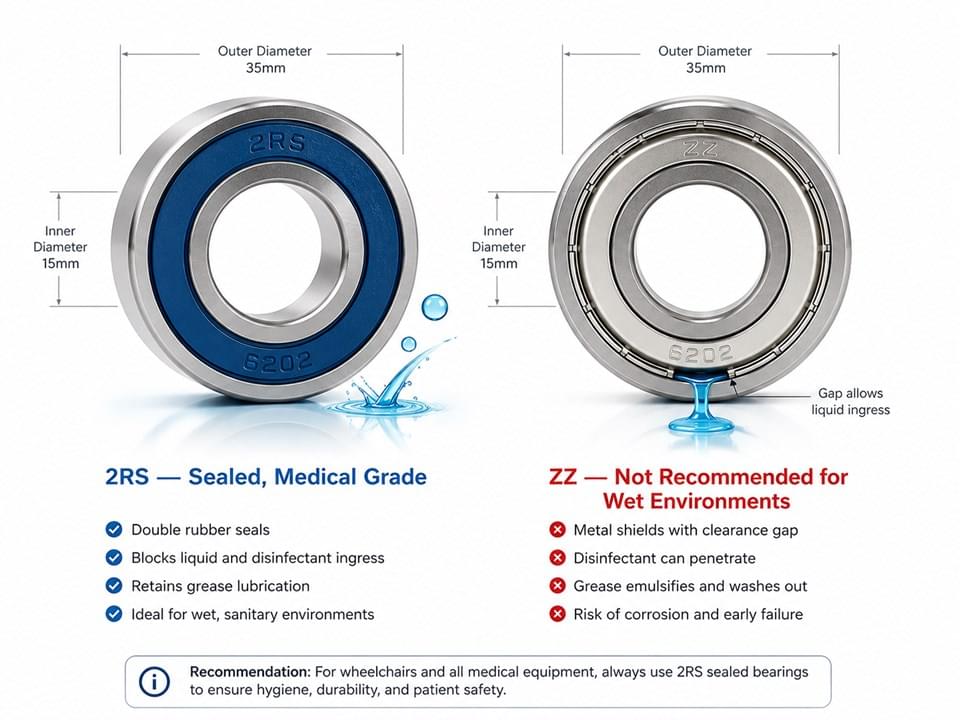
Here is the mechanism most procurement teams miss: hospital floors are cleaned with chlorine-based or quaternary ammonium disinfectants multiple times per day. These solutions form a thin liquid film that sits on the floor surface. As wheelchair wheels rotate through it, the liquid is drawn toward the bearing by capillary action. A 2RS rubber seal forms a tight contact lip that blocks this pathway. A ZZ metal shield, by design, has a microscopic gap between the shield and the inner ring — and that gap is all the disinfectant needs. Once the bearing grease emulsifies, the internal raceways begin corroding immediately. You cannot see it from the outside. The wheelchair still rolls. But the bearing is already dead inside.
Quick-Release vs. Fixed Axle: Bearing ID Differences
Another common procurement error: ordering bearings by “wheelchair model” without checking the axle type. Quick-release axles — standard on most modern institutional wheelchairs — use a 1/2-inch (12.7 mm) or 12 mm inner diameter bearing (typically 6200-2RS or 6202-2RS). Fixed-axle designs on older or budget models may use narrower axles with different bearing IDs. Always verify the axle diameter before placing a bulk bearing order. A mismatched inner diameter means the bearing either will not fit onto the axle, or will sit loose and create lateral play — both of which render the bearing useless.
03 Warning Signs
5 Wheelchair Bearing Wear Signs — With Quantitative Benchmarks
Bearings do not fail without warning. They degrade progressively, producing measurable signals long before they seize or collapse. The problem is that most institutional maintenance protocols lack standardized bearing inspection criteria. Below are five wheelchair bearing wear signs your staff can check without specialized training — including quantitative pass/fail thresholds where applicable.
1
Abnormal Noise During Operation
A healthy bearing produces a smooth, low-frequency rolling sound. A degraded bearing produces a persistent grinding, clicking, or metallic scraping noise — distinct from occasional debris friction, which stops after one wheel rotation. Rule of thumb: if the noise continues through three full wheel revolutions, the bearing race or balls are damaged. Do not lubricate and hope — lubricating a damaged bearing temporarily masks the noise but accelerates internal spalling.
2
Measurable Increase in Push Force — Quantitative Thresholds
This is the most objective bearing health indicator available to any facility. Using a simple spring scale (available for under $15), measure the initial force required to move an unloaded wheelchair from standstill on a level PVC medical-grade floor. Acceptable threshold: ≤ 12 N. A reading of 15–20 N indicates moderate bearing wear. Above 20 N, the bearing is severely degraded and should be replaced immediately. For a wheelchair loaded to 100 kg (standard patient + chair weight), the threshold shifts to ≤ 35 N. Document these readings quarterly — trending data reveals degradation rate and enables scheduled replacement before caregiver complaints accumulate.
3
Lateral Wheel Play — Side-to-Side Movement
Grip the wheel rim at the 3-o’clock and 9-o’clock positions. Push one hand while pulling the other, attempting to rock the wheel laterally on its axle. A properly seated bearing allows ≤ 1 mm of lateral displacement. Any perceptible “click” or wobble beyond 1 mm means the bearing internal clearance has widened beyond specification — the balls are no longer tracking correctly in their raceways. Continued use under this condition causes uneven loading, accelerated wear, and eventual catastrophic failure of the bearing cage.
4
Visible Rust or Discoloration on Bearing End Cap
Brown-red staining around the bearing shield or on the axle end indicates moisture has breached the seal — even if the wheel still rotates freely. This is a non-negotiable replacement trigger. Visible rust means the internal grease has been compromised, and further operation will produce metal-on-metal contact between balls and raceways. The bearing has not failed yet, but it is in the final phase of degradation. Waiting for it to seize means the inner ring may weld itself to the axle — turning a $3 bearing swap into an axle replacement.
5
Caster Swivel Resistance — Front Wheel Fails to Rotate Freely
Lift the front of the wheelchair and spin each caster by hand. A healthy caster bearing allows the wheel to rotate freely for ≥ 3 seconds after a moderate flick. If the caster stops within 1 second or cannot complete a full 360° swivel without additional force, the caster bearing has degraded. This is particularly dangerous in tight institutional corridors where nurses rely on smooth caster swivel to navigate doorways and patient rooms without jolting the occupant.
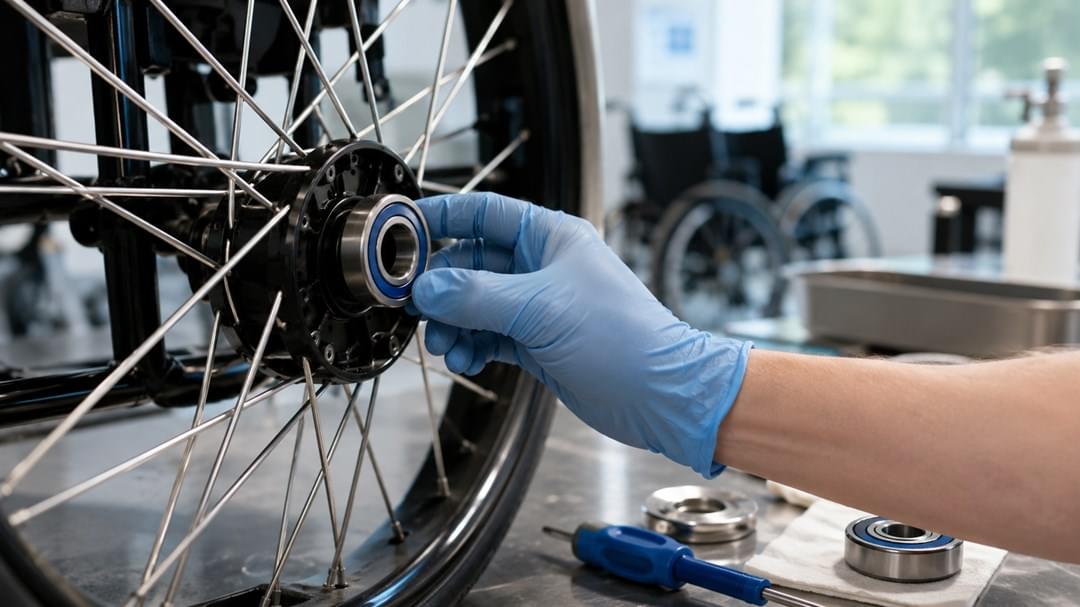
Inspection frequency recommendation: Standard institutional wheelchairs should undergo bearing inspection every 3 months. Wheelchairs in daily use exceeding 4 hours per day — common in nursing homes and long-term care facilities — should be inspected every 2 months. Document results on a per-chair checklist. Chairs flagged with 2 or more warning signs should be removed from service immediately and scheduled for bearing replacement.
04 The Cost Decision
Replace vs. Continue: Why a $3 Bearing Costs $40 When You Wait
The unit economics of wheelchair bearing replacement are brutally simple — yet most institutional procurement workflows are designed to ignore them. A single stainless steel 2RS bearing costs $1–$3 in bulk quantities. A complete 4-bearing set for one wheelchair costs under $15. But procurement departments do not track nursing labor costs against bearing condition. They track part replacement budgets. So the bearing stays in service, and the hidden cost accumulates elsewhere.
| Condition | Recommendation | Rationale |
|---|---|---|
| 1 warning sign only | Log and recheck next inspection | Early-stage wear; not yet affecting function or safety |
| 2+ warning signs | Replace immediately | Operational cost accumulation has begun; nursing labor impact is measurable |
| Visible rust | Replace immediately | Seal has failed; grease compromised; continued use damages axle and hub |
| Lateral wheel play > 1 mm | Replace immediately | Structural safety margin breached; cage failure risk escalates rapidly |
The TCO Formula: What Delayed Replacement Actually Costs
Here is the equation every facility manager should run before deferring a bearing replacement to the next budget cycle:
Delayed Maintenance Cost = Initial Bearing Cost ($8–$15) + Excess Nursing Labor Loss ($30–$50)
Where nursing labor loss = (additional push force × transfers per day × caregiver hourly rate) accumulated over the delay period
A worked example for a typical 50-chair nursing home fleet: if 20% of chairs (10 units) are running on degraded bearings, each requiring an extra 20 N of push force across 15 transfers per day, the cumulative nursing labor loss over a 3-month deferral period exceeds $450 — against a total bearing replacement cost of $120. The math is not close.
“A $3 bearing replaced on time saves $40 in labor and prevents a patient complaint.”
05 Replacement Procedure
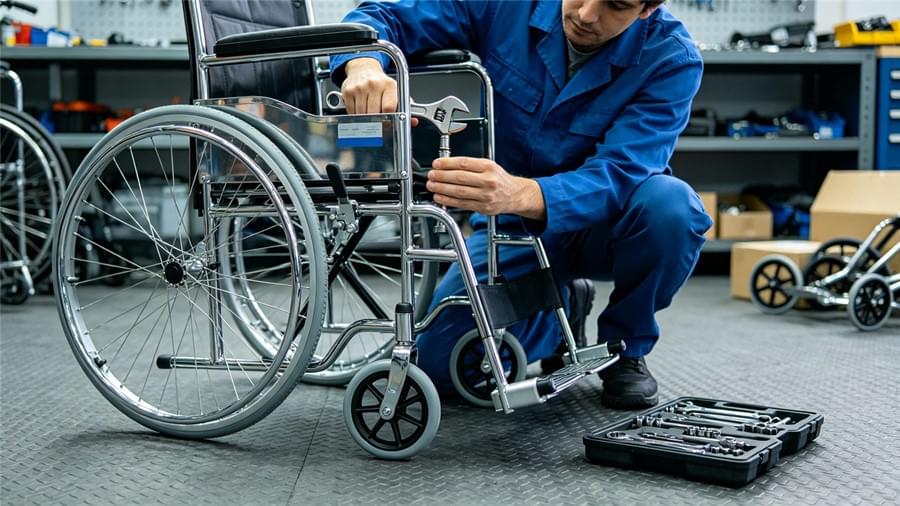
Step-by-Step Wheelchair Bearing Replacement Protocol
For facilities with in-house maintenance capability, this standardized protocol ensures consistent, damage-free bearing replacement. For distributors and procurement managers without maintenance staff, this section demonstrates the technical rigor your supplier should be able to support — if your current bearing supplier cannot walk you through these steps, they are a reseller, not a partner.
1
Gather Tools
Required: bearing puller tool (or blind-hole bearing extractor for recessed housings), bearing press or rubber mallet with installation drift, clean lint-free cloth, anti-corrosion bearing grease (lithium-complex base, NLGI Grade 2). Do not use: flathead screwdriver for extraction (damages hub bore), WD-40 as lubricant (displaces bearing grease), or hammer directly on bearing (brinelling damage to raceways).
2
Remove the Wheel
For quick-release axles: press the center button on the axle hub and pull the wheel straight off. For fixed/nut-secured axles: remove the outer locknut with an appropriate wrench, then slide the wheel off the axle. Inspect the axle surface for scoring or corrosion while the wheel is off — axle damage must be addressed before installing new bearings.
3
Extract the Old Bearing
Insert the bearing puller collet into the bearing inner bore and expand it to grip the inner ring. Apply steady, even pulling force — never use a screwdriver to pry, as this gouges the hub bore and creates an uneven seating surface for the new bearing. If the bearing is seized (common with rusted ZZ bearings), apply penetrating oil to the outer ring-hub interface and allow 10 minutes before reattempting extraction.
4
Clean and Inspect the Bearing Housing
Wipe the bearing seat clean with a dry lint-free cloth. Inspect the bore under good light for scoring, corrosion, or cracks. Any damage to the hub bore means the new bearing will not seat concentrically — leading to premature wear within weeks. If the hub is damaged, the entire wheel assembly must be replaced rather than just the bearing.
5
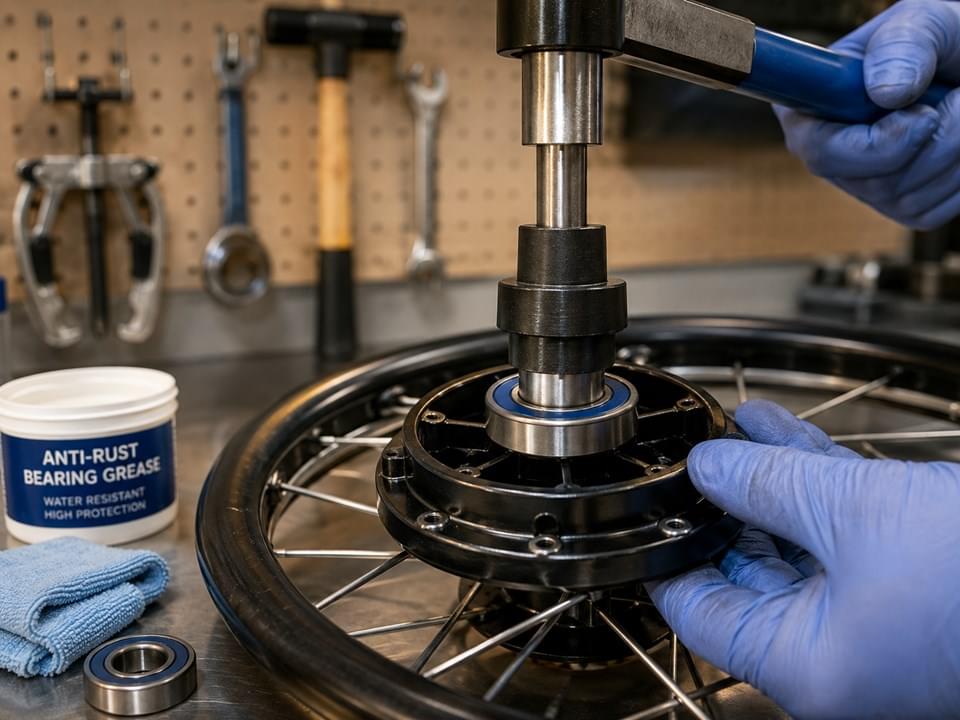
Press In the New Bearing
Apply a thin film of anti-corrosion grease to the outer ring of the new bearing. Align the bearing square to the bore. Using a bearing press or installation drift matched to the outer ring diameter, apply steady, even pressure — never impact force. The bearing will seat with a distinct “click” as the outer ring reaches the bottom of the housing. If using a rubber mallet, tap lightly around the circumference in a star pattern, never strike the inner ring or shield directly. Confirm the bearing sits flush and square.
6
Reassemble and Test
Reinstall the wheel onto the axle. Before loading: spin the wheel by hand — rotation must be smooth and silent. Apply lateral pressure at the rim to confirm no play. Load the wheelchair to 100 kg and push 10 meters on a level floor — no grinding, clicking, or resistance should be present. If any noise or resistance is detected, remove the wheel and verify the bearing is fully seated. A partially seated bearing will fail within days under load.
06 Bulk Procurement
Bulk Bearing Procurement: Specification Checklist & Supplier Evaluation
For distributors and institutional procurement teams, bulk bearing purchasing requires more than matching a model number. The specification details below determine whether your bearings last 6 months or 3 years in a healthcare environment. Use this checklist when evaluating any wheelchair bearing supplier.
5-Point Bearing Specification Checklist
☑ Bearing Model Confirmation — Verify the exact model (608 / 625 / 6200 / 6202) against your target wheelchair brand. Request a cross-brand compatibility chart from your supplier. Do not accept “universal fit” claims without model-number verification.
☑ Seal Type: 2RS Mandatory — Double rubber seal only. Reject ZZ (metal shield) bearings outright for any healthcare application. The $0.20 unit-cost savings on ZZ bearings will be consumed 50 times over by premature replacement labor.
☑ Material: Stainless Steel AISI 440C — Stainless steel bearings resist the chlorine- and quaternary-ammonium-based disinfectants used on institutional floors. Carbon steel bearings (even with 2RS seals) will corrode from the outside in once the seal lip wears — and seal lip wear is inevitable over time. Stainless provides a second line of defense.
☑ Tolerance Grade: ABEC-3 Minimum — ABEC-3 is the baseline for medical equipment applications. Lower-grade bearings (ABEC-1, or unrated “skate-grade” bearings) produce higher rolling resistance and noise — exactly the problems you are trying to solve. Satcon’s standard supply bearings are rated ABEC-3 to ABEC-5, ensuring near-silent operation in hospital corridors.
☑ Packaging Format — Bulk (loose-packed) for in-house maintenance programs; individually boxed for resale/distribution channels. Confirm packaging with your supplier before ordering — bulk bearings in a shared container risk shield damage during transit.
Cross-Brand Bearing Compatibility
A professional bearing supplier should provide a compatibility reference covering the major wheelchair brands in your fleet. Below is a representative cross-reference — we provide a complete version upon inquiry:
| Wheelchair Brand | Rear Wheel Bearing | Caster Bearing | Seal Specification |
|---|---|---|---|
| Invacare | 6200-2RS / 6202-2RS | 608-2RS | 2RS (Double Rubber Seal) |
| Drive Medical | 6200-2RS / 6202-2RS | 608-2RS / 625-2RS | 2RS (Double Rubber Seal) |
| Sunrise Medical (Quickie) | 6200-2RS | 608-2RS | 2RS (Double Rubber Seal) |
| Karman Healthcare | 6200-2RS | 608-2RS | 2RS (Double Rubber Seal) |
| Medline | 6202-2RS | 608-2RS / 625-2RS | 2RS (Double Rubber Seal) |
Supplier evaluation criteria: Beyond specification matching, verify that your bearing supplier (1) provides a documented cross-brand compatibility chart — not just verbal confirmation, and (2) maintains consistent minimum order quantities suitable for your fleet size. A supplier who cannot tell you which bearing fits an Invacare versus a Drive Medical wheelchair is not equipped to serve institutional fleets.
For the complete wheelchair bearing replacement specification sheet and full cross-brand compatibility table — including Sunrise Medical, Invacare, Drive Medical, Karman, Medline, and regional brands — contact our team. As detailed in our manual wheelchair lifecycle management guide, bearing replacement is one component of a comprehensive fleet maintenance program.
Get the Complete Bearing Specification & Compatibility Sheet
Includes a full cross-brand bearing compatibility table, ABEC-3 to ABEC-5 stainless steel 2RS bearing pricing, and bulk order MOQ — delivered within one business day.